A complete guide: how Crit’Air motorcycle sticker works
Public Health France reports that air pollution is responsible for over 40,000 deaths annually.
In major urban areas, the transportation sector alone contributes to more than half of total emissions, highlighting its significant impact on environmental and public health.
After several exchanges between the two chambers of Congress, France approved the timetable and conditions for implementing Low Emission Mobility Zones (LEZs) in July 2022. The “Climate and Resilience” law, which includes the creation of these zones, was officially enacted on August 22.
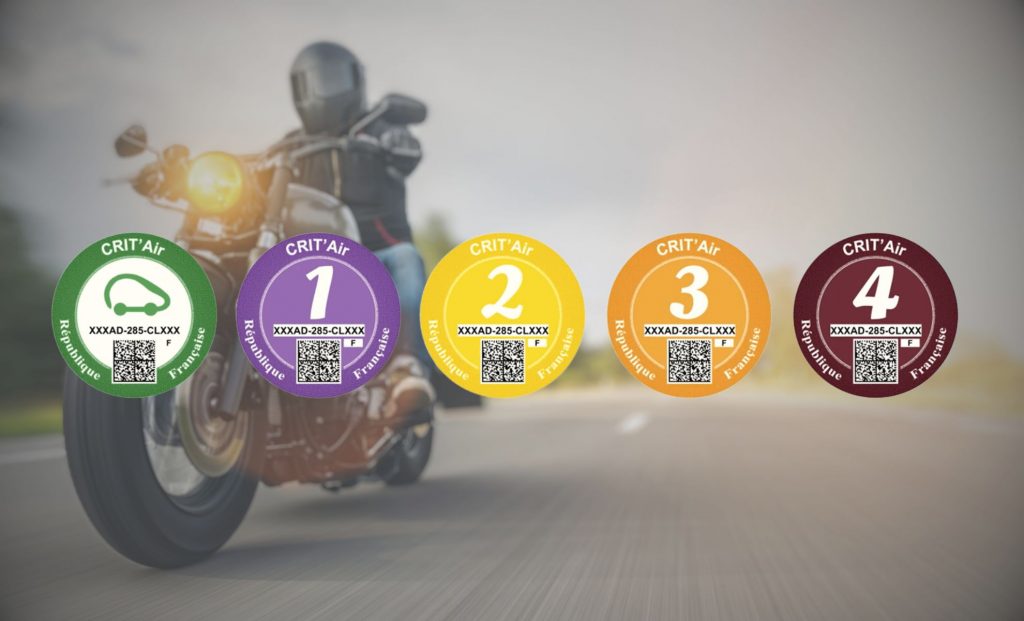
The air quality certificate, better known as the “Crit’Air sticker,” determines whether various types of vehicles—motorbikes, cars, vans, or trucks—are allowed to circulate in ZFEs. It’s based on the vehicle’s first registration date or its EURO standard, along with its engine type. Officially launched on June 24, 2016, it followed the decree establishing how vehicles are classified according to their level of atmospheric pollutant emissions.
What is a LEZ?
Low-emission zones (LEZs) are designed to reduce air pollution and improve air quality in large cities. They work by limiting access for the most polluting petrol and diesel vehicles within a specific area and during certain times set by local authorities. To drive in these zones, vehicles need a Crit’Air sticker—a coloured label with a number that indicates their level of pollutant emissions, such as nitrogen dioxide (NO2).
The Crit’Air classification is used as a reference when traffic needs to be reduced during pollution peaks. This means there’s no need for alternating traffic based on even or odd number plates—older vehicles can simply be excluded. While the classification is consistent nationwide, the specific restriction rules vary by zone. Since these rules tend to get a bit stricter every year, it’s smart to know the rating of your current vehicle or the one you plan to buy to avoid any unpleasant surprises.
How many LEZ are there?
France isn’t the only place affected by these measures. With over 230 low-emission zones across Europe, it’s clear that air pollution is a serious public health issue. Cutting down on pollutants from petrol and diesel cars is essential, making the shift toward electric vehicles and greener modes of transport a top priority.
France now has 11 urban areas with a Low Emission Zone, including Paris, Aix-Marseille Metropolis, Toulouse, Nice, Montpellier, Lyon Metropolis, Strasbourg, Grenoble, Rouen, Reims, and Saint-Etienne.
By 2025, 32 more Low Emission Zones will be set up in cities with over 150,000 residents, including places like Avignon, Bordeaux, Clermont-Ferrand, Metz, Nancy, Nantes, Orléans, Rennes, Rouen, the Lille metropolitan area, Saint-Étienne, Toulon, Tours, and Valenciennes.
Which Crit’Air sticker for which 2-wheelers?
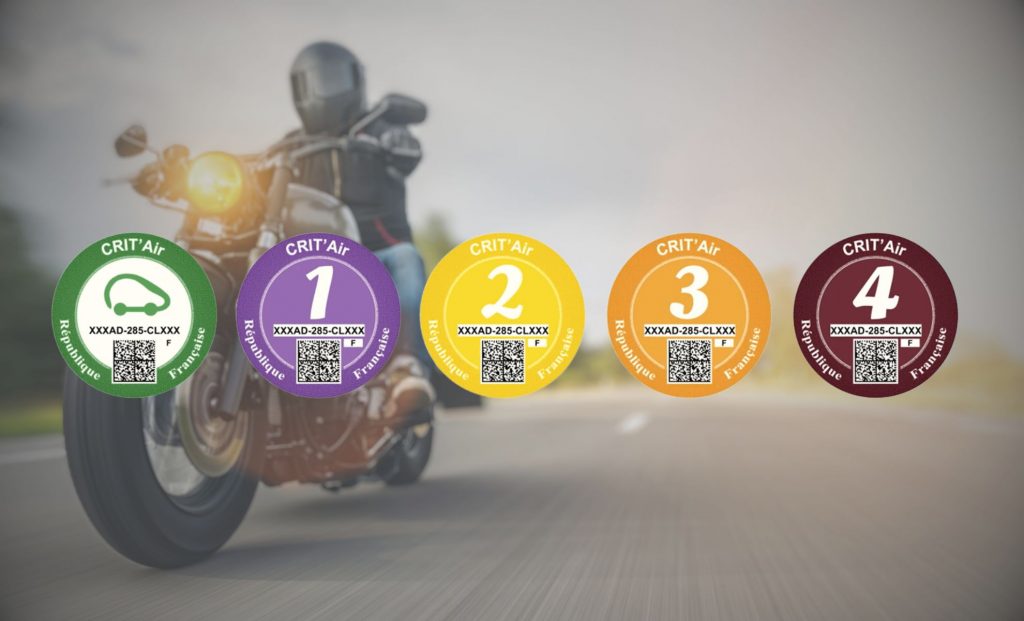
All two-wheeled vehicles are included, like motorcycles, scooters, mopeds, quads, and three-wheelers. They’re divided into five categories, with an extra green sticker for electric models such as the BMW CE04 or Super Soco bikes.
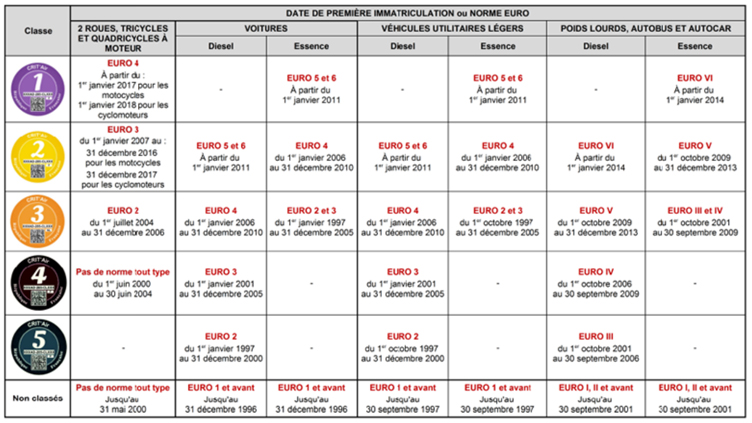
Each Crit’Air motorcycle category is marked by a specific colour and number, showing the pollution level and registration date based on the Euro standard.
If your vehicle doesn’t have a sticker because it was made before 2000, the rules depend on the zone. In Paris, for instance, you can still drive between 8 p.m. and 8 a.m. on weekdays, and all day on weekends.
Here is a summary table of the Crit’Air categories to understand which sticker goes with which 2 or 3 wheels:
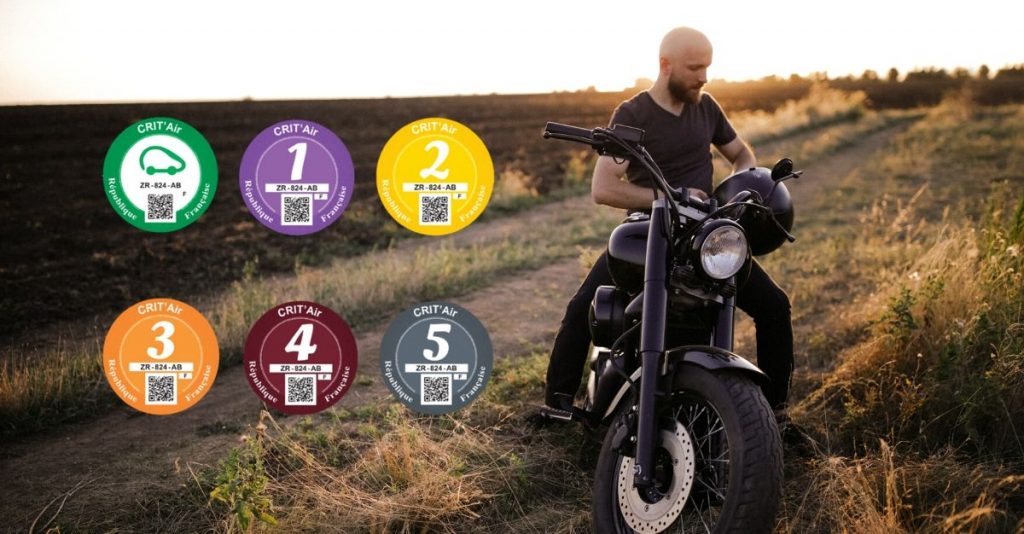
- Crit’Air 0/E – for zero emission electric and hydrogen vehicles – green sticker
- Crit’Air 1 – for plug-in hybrid vehicles and Euro 5, 6 petrol vehicles – purple sticker
- Crit’Air 2 – for vehicles that conform to the Euro 4 petrol vehicles, and Euro 5, 6 diesel vehicles – yellow sticker
- Crit’Air 3 – for vehicles that conform to the Euro 2, 3 petrol vehicles and Euro 4 diesel vehicles – orange sticker
- Crit’Air 4 – for vehicles that conform to the Euro 3 diesel vehicles – burgundy sticker
- Crit’Air 5 – for vehicles that conform to the Euro 2 diesel vehicles – dark grey sticker
Who is exempt from the Crit’air sticker?
All vehicles eligible for the Crit’Air sticker are required to display one, without exception. This includes foreign vehicles as well as those owned by individuals with disabilities who hold a disabled parking card. The Crit’Air sticker is associated with the vehicle itself, rather than the driver.
How do I get a Crit’Air sticker?
The quickest option is to order online through the official website certificat-air.gouv.fr. With your registration card and number, you can get your sticker in just a few minutes. You can also request a Crit’Air motorcycle sticker by mailing the Air Quality Certificate Delivery Service at BP 50637 59506 Douai Cedex or by emailing contact@certificat-air.gouv.fr.
Once your file is processed, you’ll get a temporary sticker for your motorcycle, scooter, or moped by email. The final certificate will be mailed to the address listed on your registration document.
How much does the Crit’Air sticker cost?
The cost of a Crit’Air sticker is identical for all vehicles, whether it is a scooter, motorbike, or car, and is set at 3.72 euros, including shipping fees. Any offer quoting a higher price indicates that the purchase is being made through a non-governmental website, which constitutes a scam.
How long is the Crit’Air sticker valid for?
The vehicle classification remains applicable throughout the entirety of its operational lifespan, thereby imposing constraints on the range and scope of procedures that can be undertaken.
What are the risks if you do not present the Crit’Air motorcycle sticker?
Riding an unauthorized two-wheeler without a valid or legible Crit’Air sticker can result in a fine of up to €450. Usually, the fine is set at €68, and the same applies if you ignore traffic restrictions during differentiated traffic measures in a pollution peak. If you pay immediately, it can drop to €45, but late payment could cost you as much as €180.
Using a fake sticker is an offense that can get expensive if you’re caught. You risk a fixed fine of €135 and a high chance of having your two-wheeler impounded.
Where to place your Crit’Air sticker on a motorcycle?
Upon receiving your certificate, it is recommended to affix it to the windshield or the fork of your motorcycle, positioned adjacent to the insurance certificate, to ensure all relevant documents are conveniently located in one place.

Article written by Nige.
Last update: December 2025
Nige has travelled to various places all over the globe on motorbikes including Europe.
We may receive a commission if you purchase a product using the affiliate links on any page of this website. This is at no cost to the purchaser, however does support our website and