
What do you think about when riding a motorcycle?
Close your eyes and imagine the thrill of riding down your favourite road. I can picture the scenery, the curves, the texture of the pavement, even the scents from countless routes across the UK and beyond. Yet, when I’m actually riding, my mind isn’t focused on any of that—those details are handled by a kind of peripheral awareness. Back in my track day days, fellow riders talked about apexes, corner speeds, and throttle timing. I can still replay laps of various tracks in my head as if it were yesterday. The truth is, when we ride, we use far more of our brain than we realize, much of it operating unconsciously—or perhaps subconsciously, which scientists say isn’t quite the same.
We have encountered such situations before, we can anticipate their actions, and we adjust our pace accordingly. Managing hazards can be straightforward once they are identified, as awareness allows for timely and effective responses.
How do I think differently on a motorcycle?
Most situations we face – whether it’s a driver on the wrong side of the road or a blind bend that suddenly tightens – are things we’ve seen and navigated before. Our brains have developed strategies to handle them. It’s not just the act of riding the bike that relies on unconscious muscle memory, but also the unfolding events ahead of us. That’s what, thankfully, lets people like me notice a chaffinch at 40 degrees of lean and still make it home in one piece… I think.
The question to consider is, “What factors should occupy your conscious mind while riding?”
Despite all my experience, I still make the same cornering mistakes I’ve made for years. I still get frustrated about turning into corners too early, and even though I can picture those roads in detail, I’ve yet to ride them the way I want after decades on a bike. I might have a strategy for dealing with hazards, but that’s not the same as having a plan to improve. The more riding skills you develop to control the bike, the more mental space you have for roadcraft and spotting hazards.
How to use mindset to be more confident riding a motorcycle
What we focus on while riding depends a lot on our skill and experience. New riders spend much of their attention on controlling the bike, leaving less mental space for roadcraft and risk assessment. They also lack the archive of past riding experiences, making the ride feel busy, intense, and sometimes stressful. Even seasoned riders who don’t regularly practice can find themselves concentrating on things others handle instinctively. Mindset plays a big role too. At a basic level, it might mean thinking “all drivers are distracted or out to get me” as a defense mechanism, but there’s a lot more positive thinking that’s far more valuable. Adopting a growth mindset lets you enjoy every ride more by focusing on improving skills and roadcraft. Even after years of riding, I still review my performance constantly—it’s like a game where I’m always aiming to level up.
Focus on the right aspects while riding, enhancing your skills through consistent awareness and self-assessment. Engage in a continuous internal dialogue, reflecting on your technique and performance as you ride, using each moment as an opportunity to refine and improve your abilities on the bike.
With my background, my machine control skills are automatic and intuitive, freeing up most of my attention for roadcraft and risk assessment. I’m always scanning for information to make better decisions, using a systematic search pattern that blends direct focus with peripheral vision. On rural roads, my main focus is the vanishing point – where I’m headed and how the road unfolds ahead. From there, I check the sides, then the mirrors, and always do a lifesaver before any manoeuvre. It’s crucial to be able to stop within the distance you can see.
Using peripheral vision allows faster reaction times
This photograph contains five significant pieces of information that can be discerned through peripheral vision. Are all of them apparent to you?
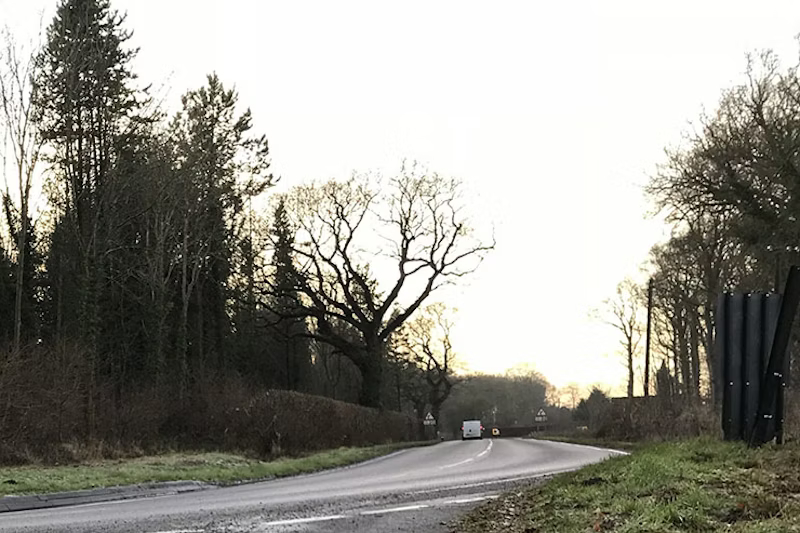
The five critical pieces of information observed in peripheral vision while approaching the road in the image above are:
- There is a right-hand turn ahead where the recommended speed decreases significantly from the posted speed limit of 60 mph to 20 mph, indicating that it is a sharp and potentially hazardous curve.
- The Chevron sign directly ahead appears to be damaged, suggesting that some drivers fail to navigate the turn successfully.
- A further chevron is visible just above the hedge, indicating that the road ahead forms a sharp 90-degree bend.
- There is a house situated just around the bend, which likely indicates the presence of a concealed driveway as well.
- The opening in the hedge to the left of the van indicates the possible presence of a side road branching off from the corner.
The vanishing point becomes significantly more discernible once the fog dissipates.
How to practice thinking differently on a motorcycle
I went out and tried doing commentary again while consciously thinking about peripheral vision, something I haven’t focused on since a training course in 2008. I also reviewed my riding as I navigated through lines of queuing traffic and the twists and turns of local back roads. At first, it felt clumsy—just like every other time I’ve tried it—and it took a lot of concentration. But this time I had guidance and a clearer purpose, and by the time I got home, it was becoming more obvious what worked and what didn’t. Cornering is a great example—if you don’t know what to practice in a corner, you’ll keep making the same mistakes. Practice only makes perfect if you’re practicing the right things, which is why corners can feel just as tricky now as they did last year if you’re not working on the right skills.
I’m decent at cornering – I’ve trained a lot and have a fair amount of confidence, but there’s still room to improve. I usually pick a good line, but I tend to turn in too early, a common habit that pushes me wider on the exit and messes up the line I wanted because I don’t get the best visibility before turning. Letting my peripheral vision handle the gap between me and the kerb helps me focus more on the vanishing point so I can be more precise about when to start turning. Doing it once is a real eye-opener, but making myself apply it to every corner and review my riding is where discipline kicks in. What starts as a challenge slowly becomes a habit, mostly because I trust my peripheral vision more to judge the kerb’s position. I run through different prompts in my head during a corner: ‘Where am I looking? Where’s the vanishing point? How far ahead can I see? What’s the safest position for oncoming traffic? When should I brake? Is the road surface good? When do I turn, and how sharply?’
While it may seem extensive when articulated, these are practices I have subconsciously followed for years. The distinction now lies in consciously vocalizing and reviewing my actions. The realization for someone with four decades of riding experience is that much of this is familiar territory. However, alongside the skills honed through years of practice, certain detrimental habits have also developed. Repeatedly practicing incorrect techniques only serves to reinforce these bad habits. The straightforward concept of assessing the ride and required actions in real time is both simple to implement and effective in maintaining focus. Moreover, rediscovering the value of peripheral vision and deliberately cultivating it has refined existing abilities, while also allowing me to appreciate the chaffinches, misplaced apostrophes, and peculiarities of GSX-R models.
For me, the takeaway was that simply knowing we have certain skills isn’t enough. Actively practicing them and reflecting on your ride in real time makes a big difference in how much you enjoy it.
So, what factors should be considered to enhance the enjoyment of your riding experience? The answer, perhaps unsurprisingly, is quite straightforward: focus on your riding itself.