1944 – 2026
So who is Peggy?
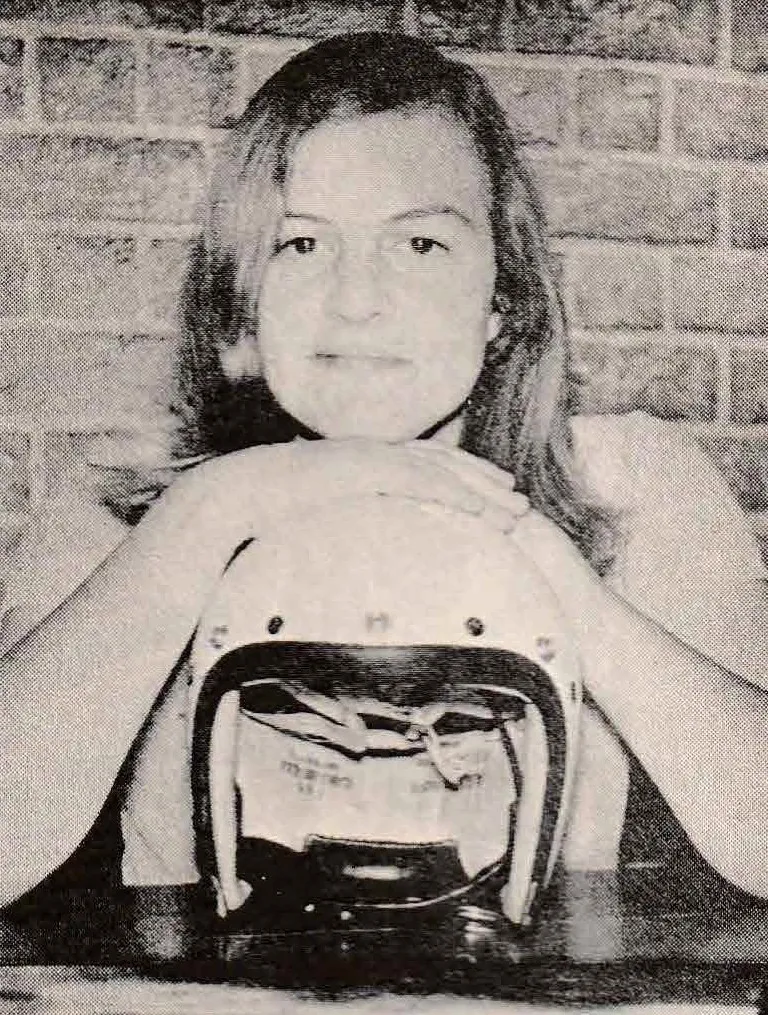
Since 1984, Peggy (real name Margaret) has called a yacht in North Queensland home, far removed from the motorcycling world—at least until Easter 2014, when she accepted an invitation from longtime friend and former racing partner Tim Parry to attend the Penrite Broadford Bonanza. There, she slipped into the same white leathers she’d worn over 40 years earlier, pulled on her old open-face Bell helmet, and hit the track on a racing motorcycle—the ex-Mike Hailwood Ducati 750SS—for the first time since 1978.
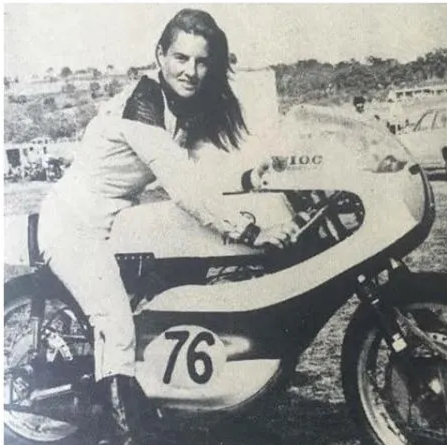
It was just a gentle ride in the Star Session, though it didn’t go quite as planned when she left the pits with the fuel turned off, but it was enough to reignite her passion. At the recent Shannon’s Australian Historic Road Racing Championships, Peggy joined the Celebrity Parade on something far more modest—Sue Scaysbrook’s Honda CB125S. The rest of the weekend saw her deep in conversation, catching up with friends and former rivals, including her great mate Kal Carrick from her Production Racing days.
Peggy, originally from Melbourne, studied music at university, though her degree was delayed after she broke her arm in a road accident. At the time, she was choirmaster and organist at Holy Trinity Church in Kensington. Looking for affordable transport, she browsed shops along Elizabeth Street but found most dealers trying to sell her a scooter, insisting that’s what women rode. Peggy wasn’t having it. She eventually met Julian Hyde, who helped her buy a steady 350cc Matchless, and later became her husband. After a crash sidelined the Matchless, she upgraded to a much bigger British bike—a 750cc Norton Atlas. When the Hydes joined the Hartwell Club, initially for the social side, Peggy developed an interest in racing. The Norton was swapped for a Suzuki T20, the go-to machine for competitive 250cc Production Racing. Her first race was at a Hartwell MCC club meet at Winton in 1967, where she and Julian shared both the Suzuki and a single set of leathers, with only a few officials knowing that “M.J. Hyde” was a woman.
Even early on, Peggy was challenging officials and pushing back against the male dominance of the sport and its rules. She initially got a Victorian Open Competition Licence without issue by simply filling out a form, but when it came time to renew, she hit a snag – the new licence limited her to bikes under 250cc. Thinking it was either a penalty or meant for juniors, she wrote to the Auto Cycle Council of Australia to protest, suggesting the all-male Victorian Committee might be to blame. She received an apology and an unrestricted Open Licence. What she didn’t realize then was that it was the first unrestricted licence in the world for a woman to race, and, surprisingly, that remained true for the next 15 years. In that regard, Australia was leading the world.
We went through bikes pretty fast because we commuted a lot from the Dandenong Ranges into Melbourne. Geoff Cook from Kawasaki Motorcycles tried to convince me to buy the first model H1 triple, even though I already had a Yamaha TR2B for racing. He kept at it, so eventually I bought an H1 at cost, with the bonus that he offered me $100 off the price for every race I won.
I had already paid about $400 off the bike when I started winning races, but Geoff Cook refused to pay. He ended up suing me for the remaining balance and a bunch of ridiculous claims, but in the end, he lost and had to cover all my costs—so that was that! I really liked the H1, though it had its quirks.
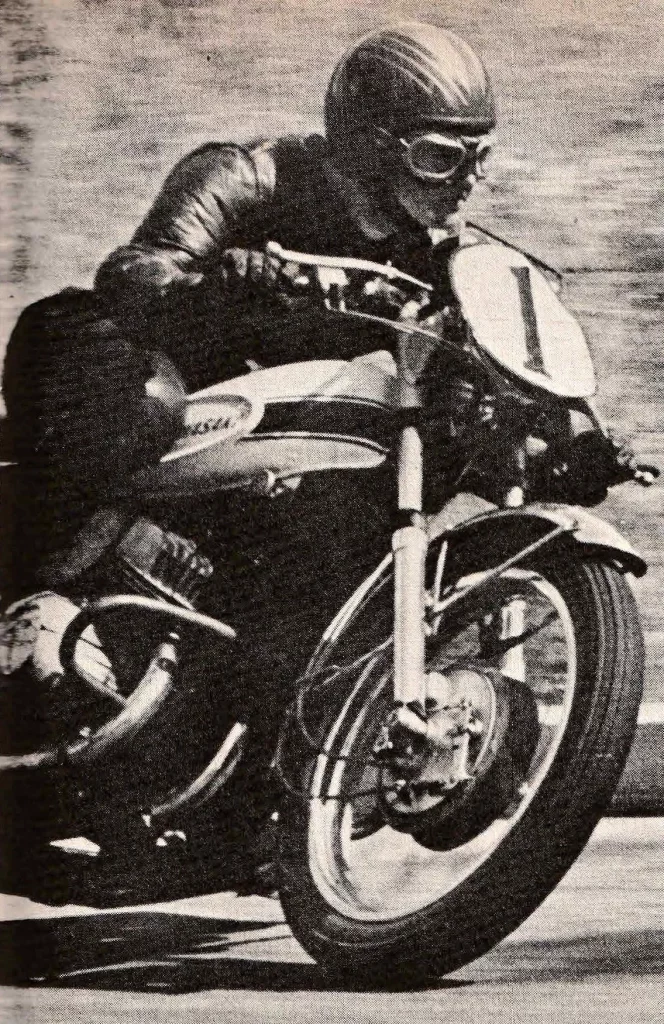
Peggy’s first outing on her new Kawasaki was at the South Australian Grand Prix in Mallala. To break in the bike, she rode it to and from the event, finishing sixth in the Senior GP and pocketing $3 in prize money. On New Year’s Day 1970 at Phillip Island – which also hosted the Australian TT, the official national championship – 26-year-old Peggy showed her skill with the challenging triple. As reported by The Australian Motor Cycle News, over two days of racing she claimed not one but three wins. Her convincing victory in the Senior C Grade Race on Saturday made her the first woman to win a road race against male competitors, earning her spots in the Senior and Unlimited TT title events on Sunday – another groundbreaking first for a woman.
While this report is mostly accurate, British rider Beryl Swain made history as the first woman to compete solo in the Isle of Man TT, entering the 1962 50cc race and finishing 22nd out of 25. Her achievement, however, quickly led to a ban on female road racers in all classes, which stayed in place until 1978. Before her, several women had appeared as sidecar passengers, most notably German Inge Stoll, who partnered with Frenchman Jacques Drion in the 1954 and 1957 TTs, as well as numerous Grands Prix and international events, until both tragically died in a crash at the 1958 Czech Grand Prix.
That Phillip Island weekend marked the start of an incredible year for Peggy. A few months later, at the prestigious Harvey Wiltshire Memorial meeting at Calder, she truly proved her skill – not in graded races, but in the all-comers Production Race against big names like Australian Unlimited Champion Ken Blake (Kawasaki H1) and multiple Australian TT winner Peter Jones on a T500 Suzuki. After a slow start, Peggy had to fight hard to catch the leaders, but with determination, she cut through the pack. As The Australian Motor Cycle News reported: “On lap two she took the lead from Jones, and then, in a bid to save male pride, he slid off on lap three and retired. From then on, Hyde held a two-second lead over Blake, who made a last-lap attempt to restore male honour but also fell at Shell Corner!” Peggy still chuckles at the memory. “Jeff Curley had the best time watching that race because he’d seen these young blokes with their modern bikes, while he was battling on a Triton. I had a poor start and must have passed Jeff early, so he saw it all happen. I even rode an extra lap because once before I’d been robbed of a place by a steward’s wrong flag, so I wanted to be sure. When I came in, a crowd, including Jeff, blocked my way. Jeff was thumping me on the back, laughing, and I was breathless. He kept saying, ‘They all fell off! They all fell off!’ For him, it was the sweetest thing – those young guys he’d been competing with fell trying to pass me back after I overtook them.”
Like most top riders, Peggy got herself a 350 Yamaha TR2B to compete in the main Junior and Senior classes. At the time, she was working for Milledge Brothers, Yamaha’s distributors in Victoria, which meant she could buy the bike at cost. The deal included a mechanic, which she hadn’t wanted, but she was outvoted. The TR2B was a simple two-stroke, easy to tune—just flick the back wheel and it would start—but her spares kit, supplied with every new racing Yamaha, ended up supporting other bikes. She was likely one of the few riders with a pair of TR2 barrels that had never seized, even though the chrome on the bores wore through from constant racing. The bike was extremely reliable, with pistons changed after nearly every meeting. After moving to NSW, the TR2B stayed in Victoria, and she lost a year of racing trying to get it back—one of the reasons she dropped from B Grade to C Grade, to get more rides.
After retrieving her TR2B from Melbourne, Peggy moved to Wiseman’s Ferry, northwest of Sydney, when Julian accepted a job at Macquarie University. There, she ran a commercial goat dairy and continued breeding cattle dogs and Toggenburg goats. On the racing circuit, she picked up right where she left off, swapping Phillip Island, Calder, and Winton for Oran Park, Amaroo Park, and Mount Panorama, Bathurst. Living in Sydney also meant she was perfectly positioned to compete in the state’s biggest event – the Castrol Six Hour Race at Amaroo Park.
Peggy raced in the inaugural Six Hour, officially called the Castrol 1000, in 1970 on her own Kawasaki H1, with Jeff Curley initially set as co-rider. When Jeff was injured before the race, Rod Tingate stepped in. By then, the bike was old, with about 10,000 miles on it and a shilling-sized piece broken out of the crankcase from being dropped, which Peggy hadn’t noticed. During scrutineering, officials didn’t like her flattened mufflers; she joked they’d be flat again after a few laps, but had to pull them off that night to reshape them. The next morning, one muffler had a small crack, so she wired it up, which kept it on when it eventually came loose, though it still cost about 20 laps. Despite that, they finished just one lap behind Ken Blake and Kal Carrick, whose H1 handlebars snapped mid-race, forcing repairs that cost them time. They still managed 295 laps and third in the 500cc class. Peggy had been lapping faster but was disappointed the prize only went to third place.
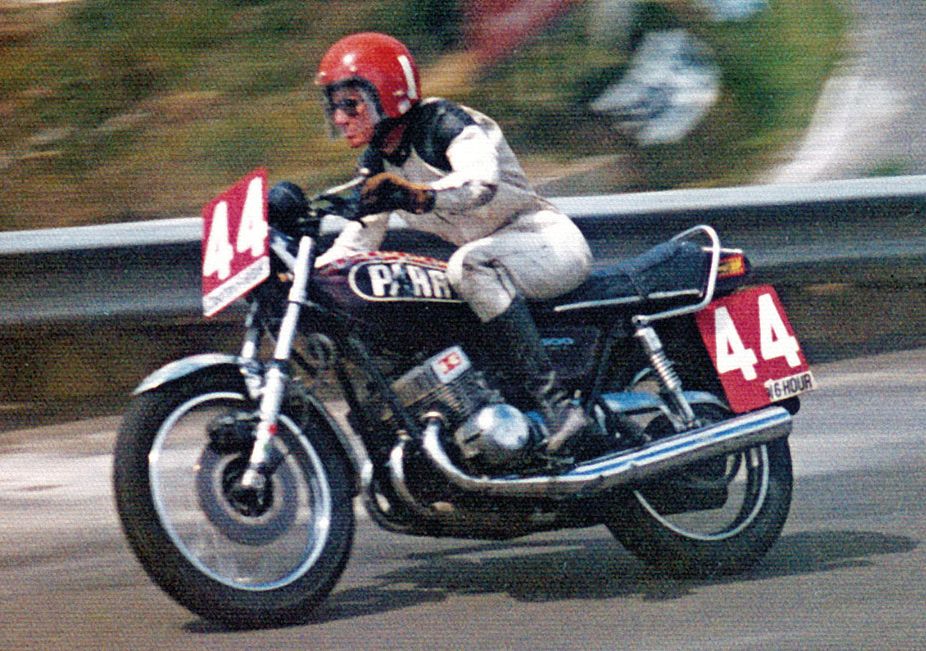
The next year, Peggy teamed up with Janet Middleton on Janet’s Kawasaki S2 350 triple, entered by Parramatta dealer Barry Ryan. Peggy rode nearly the entire race, as she was much quicker than Janet, but a coil failure halfway through ended their run. In 1972, she switched to a Honda CB500/4 with experienced co-rider Gordon Doble, but confusion over lap scoring cost them 100 laps, leaving them 11th in the 500 class with 213 laps. Her fourth and final Six Hour was in 1974, when Kawasaki dealer Tim Parry entered a 500cc H1 for himself and Peggy, but a crash ended their efforts. “My leathers, still with ‘Parry’s’ across the back, are hanging in the shed along with the helmet I used,” Peggy recalls, 40 years after that race.
Tim Parry remembers the 1974 race with fondness. In mid-1974, Peggy Hyde and her husband Julian walked into my shop, Parry Motorcycles at Pennant Hills, and asked if we’d sponsor her in the upcoming Castrol 6 Hour Race. They said if we supplied the bike, covered entry fees, tyres, fuel, and so on, she’d bring her wealth of racing experience. Like every Sydney motorcyclist, I was captivated by the 6 Hour at Amaroo, and as a Kawasaki dealer I understood the “win on Sunday, sell on Monday” appeal—so it didn’t take much convincing. Her choice of bike was perfect for us: a 500 Kawasaki H1. We pulled a low-kilometre, second-hand, disc-braked triple off the floor and dove into an exciting six weeks of prep. The lead-up flew by in a blur of long days at Amaroo for scrutineering, practice, and serious racing talk—like using the back brake to improve the H1’s poor right-hand ground clearance. It was incredible rubbing shoulders with the greats of the day: Willing, Hansford, Toombs, Eastmure, Hindle, Atlee, Hinton, Ahearn, and others. The race itself was a bit of a letdown. Peggy started, but the bike developed a miss. After several pit stops, we swapped the plugs, which fixed it. My stint after the first hour was slow and uneventful. During Peggy’s second turn, she was forced wide by a rider on a 750 Honda at the top of Bitupave Hill and ran off into the infield. Footage of her wild ride through the bush and rocks made every 6 o’clock news.
Peggy reluctantly sold her TR2B Yamaha and replaced it with a Z1 900 Kawasaki, which she used both for commuting and Production Racing. By the mid-seventies, though, her passion for racing was giving way to other interests. After divorcing Julian in 1979 and facing serious health issues that required major surgery, she turned to sailing. Unable to continue in her trained profession, she took a year off, explored the seas, and ended up in the Gulf of Carpentaria. From there, she went to Cairns, bought a yacht, and after many adventures and earning another degree, she’s still living aboard in the tropics.
Throughout her racing career, Peggy believed that, regardless of gender, the three key ingredients for success were talent, judgment, and motivation. While many riders might have two of these qualities, she felt only the very best possessed all three.
Statement from Motorcycling Australia
Motorcycling Australia is mourning the passing of 82-year-old Peggy Hyde, who cut a swathe through local road racing in the 1960s and 1970s, setting precedents and benchmarks for female participation in what was then a male-dominated sport.
The Melbourne-raised Peggy (or Margaret Moorhouse to others) began road racing at Winton in 1967 (sharing a Suzuki T20 with her partner, Julian) on an open competition licence – the first woman in the world to do so.
A couple of years later she purchased a Kawasaki H1 triple, which could be a tricky proposition at the best of times, but in her first meeting at Mallala she rode it to the event to run it in and finished sixth in the Senior GP – taking home three bucks prizemoney!
In 1970, she really started to form a potent combination with the H1, and in the Harvey Wiltshire Memorial meeting at Calder star duo Ken Blake and Peter Jones both crashed trying to keep Peggy in their sights.
By the late 1970s Peggy’s life was moving on from racing – sailing and the tropics became a huge passion – but she did make an appearance at the 2014 Broadford Bike Bonanza riding the ex-Mike Hailwood Ducati 750SS using her 40-year-old leathers!
Peggy also became a staunch advocate for environmental causes in far-north Queensland, as well as continuing to champion a variety of female issues, particularly domestic violence.
Vale Peggy: a true trailblazer for women in motorcycling and someone who lived life with absolute conviction.