On May 2nd and 3rd, 2026, the Straightliners event will hit Pendine Sands, bringing high-octane land speed racing with a thrilling variety of vehicles. It’s set to be an adrenaline-packed experience, ideal for motorsport lovers and speed enthusiasts alike.

Pendine Sands, Carmarthen, Carmarthenshire, SA33 4NY
Pendine and the World Land Speed Record
For a brief time in its history, Pendine was at the heart of World Land Speed Record attempts. From 1924 to 1927, the record was pursued, won, and held there. The sands stretched seven miles, hard and flat, capable of supporting large vehicles. Back then, only Pendine and Southport Sands were suitable in the country for such record attempts. Even so, racing at high speeds on them was risky. Malcolm Campbell was the first to take on Pendine, and in September 1924, he set a new record of 146.16 mph in his Sunbeam Bluebird. He returned in July 1925 and, with the same car, pushed the record to 150.766 mph.
In October 1925, John Godfrey Parry Thomas arrived with his car, Babs, powered by a 27-litre Liberty aeroplane engine. Bad weather cut his attempt short, and he left disappointed. He returned in April 1926 and set a record of 168.07 mph on Tuesday, April 27th. The next day, after tweaking the carburettors, he pushed it to 170.624 mph for the mile. Then it was Malcolm Campbell’s turn, coming back with his new Napier Campbell Bluebird. In February 1927, he reclaimed the record at 174.223 mph. Thomas made another bid with Babs, but tragically died on March 3rd, 1927, when the car crashed during his attempt. Just days later, Segrave topped 200 mph at Daytona. Pendine was no longer suited for such speeds, and the racers moved on.
Record Breakers
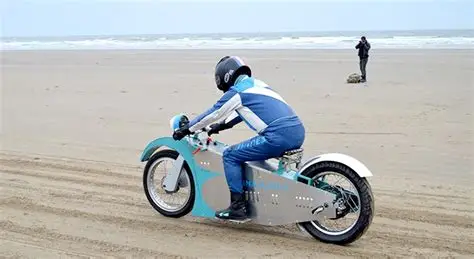
The death of J.G. Parry Thomas at Pendine in 1927 brought an end to World Land Speed Record attempts there. Just days later, Henry Segrave pushed the record past 200 mph, hitting 203.79 mph at Daytona, Florida. The sands, however, have continued to draw speed enthusiasts. In June 2000, Don Wales—grandson of Malcolm Campbell and nephew of Donald Campbell—set the UK electric land speed record at Pendine Sands in Bluebird Electric 2, reaching 137 mph. Then in May 2010, he set a world record for a lawnmower at 87.833 mph.
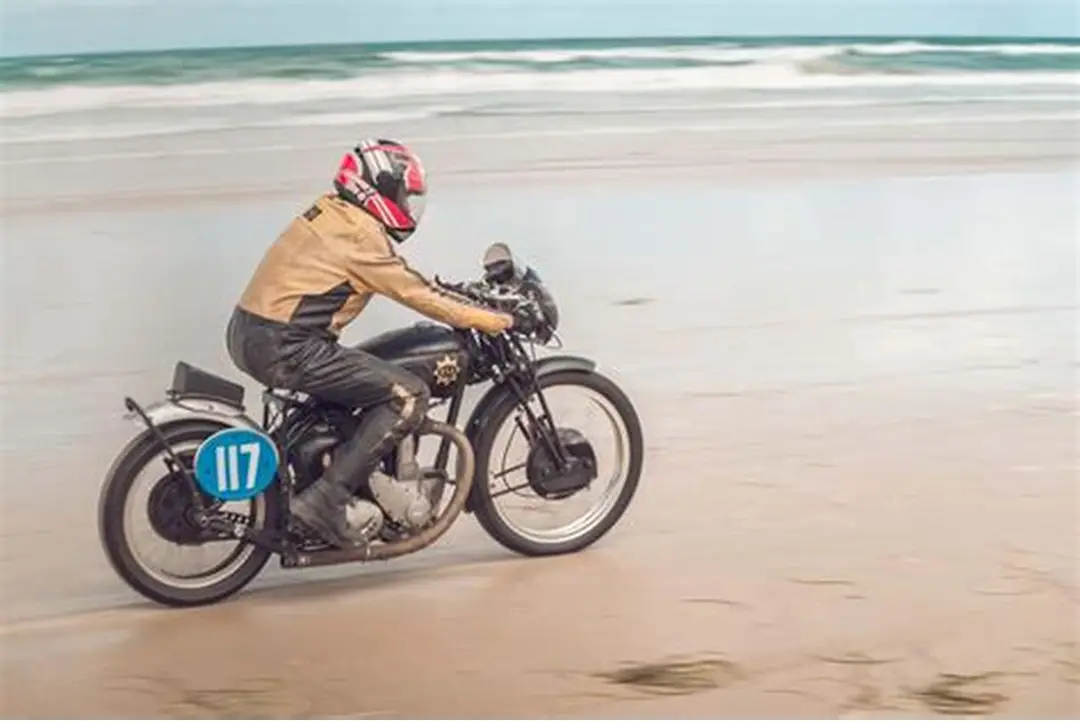
Pendine and Malcolm Campbell still hold the British Land Speed Record. The last attempt to break it there was in 1927, when Guilo Foresti tried in a straight-eight, 10-litre supercharged Djelmo racing car. He crashed, failed, lost his hair, but survived. In 1932, Captain George Eyston set the British record for cars in the 500–750cc class, hitting 116.89 mph in the MG EX127. Eyston later held the World Land Speed Record, though not at Pendine. In the 1950s, George Brown tried for the motorcycle world record, reaching 150 mph on his 998cc Vincent-based “Nero,” but it wasn’t enough. Bob Berry also made several attempts between 1949 and 1961, lying prone on his bike to reach 186 mph, later adding a streamlined shell before crashing at 167 mph and breaking his collarbone. Other record seekers, including Barry Bowles, Alan McFazdene, and blind driver Peter Wood, have come to Pendine, with mixed success. More will try in the years ahead, though driving on sand at over 100 mph is far more dangerous than it looks.
In 2015, Guy Martin set a new Land Speed record for a bicycle, achieving an impressive speed of 112 mph on Pendine Sands. Later that year, on 7 May, Idris Elba broke the historic ‘Flying Mile’ record, originally established by Malcolm Campbell, driving a Bentley Continental GT Speed.
Leave a Reply