The hippie trail, also known as the overland, was a popular journey from 1957 to the late 1970s, taken by members of the hippie subculture and others. It ran from Europe and West Asia through South Asia, passing through countries like Afghanistan, Pakistan, India, Nepal, Sri Lanka, Bangladesh, and ending in Thailand.
This alternative form of tourism focused on traveling as cheaply as possible to maximize time away from home. The term “hippie” emerged in the mid-to-late 1960s, replacing the earlier term “beatnik” from the late 1950s.
At every significant stop along the hippie trail, there were hotels, restaurants, and cafés catering to Western travelers, who frequently connected and socialized with one another as they journeyed both east and west. The hippies generally engaged more with the local population than traditional tourists, fostering a greater degree of cultural exchange and interaction.
The hippie trail came to a significant end in the late 1970s, primarily as a result of two major geopolitical events: the Iranian Revolution, which established an anti-Western government, and the Soviet invasion of Afghanistan, which effectively closed the route to Western travelers.
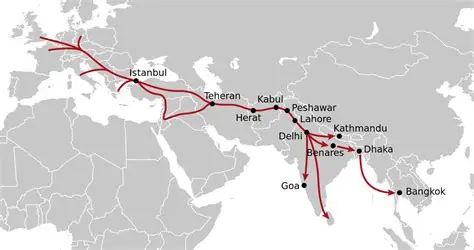
Journeys often began in cities across western Europe, such as London, Copenhagen, West Berlin, Paris, Amsterdam, or Milan. Many travelers from the United States flew Icelandic Airlines to Luxembourg. Most trips passed through Istanbul, where routes split. The northern route usually went through Tehran, Herat, Kandahar, Kabul, Peshawar, and Lahore before heading to India, Nepal, and Southeast Asia. Another option was traveling from Turkey via Syria, Jordan, Lebanon, and Iraq to Iran and Pakistan. All travelers crossed Afghanistan and the Khyber Pass, passing through Peshawar and Lahore in Pakistan, and crossing the Pakistan-India border at Ganda Singh Wala, or later at Wagah. The Hippie Trail never had a single official route or a definitive starting and ending point.
Popular destinations in the East included Delhi, Varanasi (formerly known as Benares), Goa, Bombay, Madras, Kathmandu, and Bangkok. Kathmandu still boasts a road, Jhochhen Tole, nicknamed Freak Street in honor of the thousands of hippies who once passed through. Travelers often ventured further to southern India, visiting Kovalam Beach in Trivandrum (Kerala) and Sri Lanka (then called Ceylon).
Kathmandu was often the endpoint of the hippie trail, since Tibet was off-limits and traveling overland through Burma wasn’t possible. India had heavily restricted access to Burma due to clashes between insurgents and Indian armed forces, and the Ledo Road crossing had fallen into disrepair, largely reclaimed by the jungle. Still, travelers could fly from Kathmandu to Bangkok to continue through Southeast Asia—visiting Thailand, Malaysia, and Indonesia, where Bali was a popular hippie destination. From Indonesia, there was also the option to head to Australia by plane or ship. This route from Timor to Thailand became known as the Hippie Trail Southeast Asia Extension, attracting mostly Australians and New Zealanders traveling in the opposite direction overland to London.
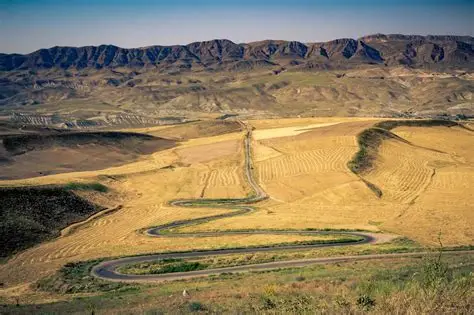
The hippie trail ended in the late 1970s due to political shifts in once welcoming countries. In 1979, the Iranian Revolution and the Soviet invasion of Afghanistan shut down the overland route to South Asia for Western travellers, while tensions and territorial disputes made Chitral and Kashmir less appealing. Meagan Day noted that “radio stations in Iran swapped Blue Öyster Cult for speeches by Ayatollah Khomeini.” Other events contributing to tough conditions for travellers included the Saur Revolution in 1978 and the rise of a military dictatorship in Pakistan in 1977, which banned many hippie attractions.
Along the Middle Eastern route, the Yom Kippur War in 1973 led to strict visa restrictions for Western citizens in Syria, Iraq, and Lebanon. The Lebanese Civil War had already erupted in 1975. Around the same time, Richard Nixon launched a drug war that targeted cannabis as well. Under constant pressure from the USA, Nepal enacted the Narcotic Drugs (Control) Act in 1976, banning the trade, cultivation, and any cannabis-related activities in the country.
Since the mid-2000s, the route has become somewhat viable again, though ongoing conflict and tensions in Iraq and Afghanistan it far more challenging and risky than during its peak. In September 2007, Ozbus launched a short-lived service between London and Sydney along the hippie trail, and by 2010, commercial trips were offered between Europe and Asia that avoided Iraq, Afghanistan, and Pakistan by traveling through Nepal and China to connect with the old Silk Road.